Fashion as Culture
Are Statement Shoes the New Recession Indicator?
As consumers become more cautious, Spring/Summer 2027’s wildest footwear suggests that one extraordinary shoe may be doing the emotional work of an entire new wardrobe.
By Anna Anisin · October 13, 2026 · 5 min read
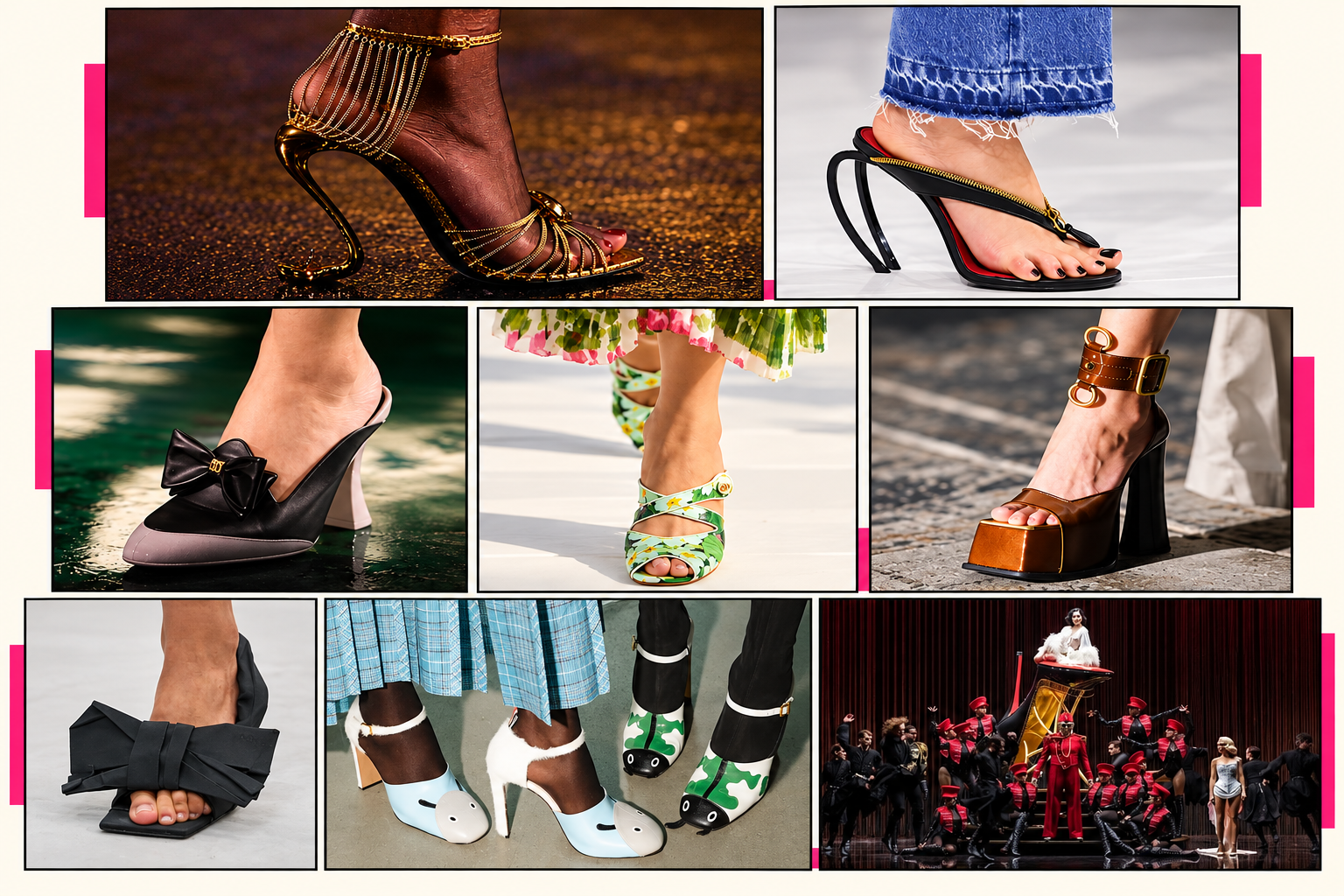
This is my favorite time of the season. Fashion month is over, the extraordinary shoes are finally everywhere, and shoes feel exciting again. Am I buying them all right now? Absolutely not. I know myself, and I will happily wait for the pairs I love to go on sale. But I am thrilled by how much choice, personality and sheer fun is coming back to footwear.
After a month of collections, the most persistent images were not always the dresses. They were at ground level: Thom Browne’s whimsical, insect-like heels; Chanel’s intricately embellished footwear; Givenchy’s sculptural sandals; and Loewe’s beaded, textured mules. Across New York, London, Milan and Paris, shoes stopped behaving like supporting characters. They became the plot.
That timing has inspired a familiar question across fashion feeds: is the return of the outrageous shoe a recession indicator?
Fashion has always loved an economic theory. There is the hemline index, the lipstick effect and the so-called high-heel index, the idea that heel heights rise when the economy falls. None of these is a reliable forecasting tool. A shoe cannot tell us what GDP will do next. But a runway can reveal a mood, and the mood of Spring/Summer 2027 is remarkably clear: after years of restraint, practicality and quiet luxury, fantasy is moving closer to the ground.
The Fantasy Is in the Footwear
The season’s shoes are not merely high; they are strange, tactile and specific. Pleats flare like wings. Beads turn mules into jewelry. Heels curve in directions that appear to challenge physics. Familiar pumps arrive in saturated color, while otherwise sensible flats become witty little objects.
This is not escapism in the form of an entirely new wardrobe. It is escapism concentrated into one piece.
That distinction matters. McKinsey’s State of Fashion 2026 describes consumers as increasingly value-conscious amid economic volatility, while Bain’s luxury research points to only a gradual recovery and continued pressure on leather goods and footwear. People have not stopped wanting beauty. They are simply asking purchases to work harder.
A remarkable shoe can do exactly that. It can change a black dress you have worn for five years, sharpen the trousers already in your closet, or turn denim and a white shirt into a point of view. The purchase may still be indulgent, but its impact is immediate and repeatable.
The New Lipstick Effect May Be an Outfit-Making Shoe
The classic lipstick-effect theory suggests that, in uncertain times, shoppers may trade a larger luxury purchase for a smaller, emotionally satisfying one. Shoes are not inexpensive in the way lipstick is, particularly at designer prices. But the underlying impulse feels relevant: choose one visible object that delivers disproportionate pleasure.
The Spring/Summer 2027 runway shoe is designed for that role. It photographs beautifully. It communicates taste without requiring a logo. And unlike a full runway look, it can live inside a real wardrobe.
This may also explain why the season feels simultaneously restrained and eccentric. The clothing at many houses emphasized lightness, practical wardrobes and individual styling. The shoes supplied the punctuation. They were the exclamation point beneath a sentence made from pieces we may already own.
Not a Forecast, a Wardrobe Strategy
The smartest response is not to chase every surreal heel that appears online. It is to identify the pair that changes the largest portion of your closet.
Ask three questions:
1. Can I wear it with at least five things I already own?
2. Does it express something my current wardrobe does not?
3. Will I still want to reach for it when the trend conversation moves on?
If the answer is yes, the statement shoe stops being a novelty. It becomes a strategy.
That is the opportunity behind this runway moment. Cautious spending does not have to mean invisible dressing. It can mean buying less, choosing better and demanding more imagination from each piece. The shoe becomes the place where personality survives the edit.
Anna’s Take
This is genuinely my favorite moment of the season: the shows are over, the shoes are out in the world, and I can start deciding which ones I might actually want in my life.
I am excited, but I am also realistic. I am not rushing to buy every pair at full price. I will watch, make my list and wait for the sales, because that is how I shop. The fun is seeing what is possible now: sculptural heels, saturated color, embellished flats and wonderfully strange shapes that can make the clothes we already own feel completely new.
After years when shoes sometimes felt overly sensible or interchangeable, shoes are cool again. There is personality, humor and drama at every height, and there are more choices for more kinds of women. Honestly, yay.
The best shoe of the season will not simply be the one that looked most spectacular on the runway. It will be the one still on my mind when the markdown arrives, and the one that makes me see my own wardrobe differently.
Which pair are you waiting for?
Further reading